
Hello, my name is Aaliyah Claxton and I am, a freelance songwriter and A&R executive for Atlantic Records.
Pensions are a secure income for life which increases by at least the rate of inflation each year. They apply to those who are of retirement age, the current retirement age is 65 years old, but this is likely to change in the future. Pensions are defined by regular made payment by the state to people of the national retirement age, they also apply to widows and those with disabilities. During a person’s employment years, a sum of money is added, to support the persons retirement. The money is paid periodically (£168.60 a week) after retirement. Entitlement to the pensions are built up through contributions to N.I (national insurance) during your working years -of which must be 35 to get a full pension or at least 10 to get any. Pensions are an important part of planning the retirement process. Pensions for those who are not employed by corporations can be more difficult as there is no one to assist in choosing a pension scheme, no guaranteed regular income patterns and no employer contributions. Through self-assessment those who are not employed by companies can still receive government pensions by filling out details and paying towards their N.I, as this record is what determines how much state pension you receive. On the other hand, private or personal pensions are optional, the money received from these at retirement depends on how much has been invested in and on whether the performance of the economy and your investments is good. Regular contributions can be made, or it can be done ad-hoc where only one-off payments are made, and the pension provider adds tax relief. Private pensions can help support any money that you receive from government pensions which is just over £8,750.00 a year.

This self-assessment sheet is of someone who earns a medium income. The sheet shows that this person earns £17,500, above the threshold for which tax should not be taxed which is £11,500. This person will automatically have 20% of tax removed from their final income. That means that £6000.00 of their income lies in the 20% tax threshold. 20% of £6000 is £1,200, which in result means, this amount will go towards tax. However, some of this goes towards N.I contributions (£840.24) for state pension. In total, the government is owed £2,040.24. It is important to pay this on time and also save to ensure that you have enough to pay this, as if not there are various consequences.
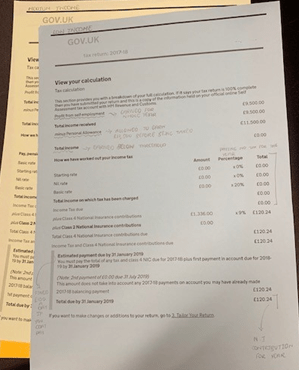
This self-assessment sheet is of someone who earns a low income. The sheet shows that this person earns £9,500, which is below the threshold for which you can be taxed- £11,500. This person will not have tax removed from their final income. To be taxed they must begin earning above £11,500. However, their N.I contribution is £120.24 which must be paid.
Tax is a compulsory contribution to state revenue, taken by the government on workers’ income and business profits, or added to the cost of some goods, services, and transactions. Taxes are involuntary and enforced by a government entity of which can be local in order to finance government activities. The money is used to help fund public works and services and to build and maintain the infrastructures used in a country and for the betterment of citizens. The money could be income earned from salary etc. Only a percentage of the taxpayer’s earnings or money is taken and if you do not earn above the first threshold- Personal Allowance of up to £12,500.00- you may not be taxed. Payment of taxes at rates imposed by the state are compulsory, and tax evasion – of which is the deliberate failure to pay one’s full tax – is punishable by law. Most governments utilize an agency or department to collect taxes. In the UK most taxation is payed forward to Her Majesty’s Revenue and Customs (HMRC) and local councils. If employed, paychecks are taxed automatically but if you are self-employed, you must rely on self-assessments to pay tax forward. Self-assessment is a system used to collect income tax that must be filled in after the tax year it applies to for example April 5th. Tax returns can be done in both paper and online forms, in order to fill them in correctly you must keep records – for example bank statements and receipts. The more you earn, is the higher you will fit in on the tax threshold and the more you will have to pay: the less you earn, the lower you will sit on the threshold and the less you will have to pay.
| Band | Taxable income | Tax rate |
| Personal Allowance | Up to £12,500 | 0% |
| Basic rate | £12,501 to £50,000 | 20% |
| Higher rate | £50,001 to £150,000 | 40% |
| Additional rate | over £150,000 | 45% |
Tax evasion of which is the deliberate failure to pay tax- can result in jail time of up to six months or a fine of up to £5,000 fine, the maximum penalty is an unlimited fine and seven years maximum in prison. The provision of false documentation in order to pay less can result in penalties up to and above a £20,000 fine or up to seven months in prison. Assests can also be seized or liquidized by government officials for debts owned, resulting in bankruptcy of which can cause restrictions with banks and future loans etc. Accountants can be hired to handle these affairs, the hourly rate of one costs between £60 and £80.
Invoice
An invoice is effectively a bill. It is a payment demand used by a seller to a buyer. It details what goods have been provided or the work done and how much must be paid in return. Invoices can be used to bill for one-off projects or for recurring work, but they are most widely used to request payment after work is completed, and where there is an ongoing relationship with the customer. Traditionally, invoices are in paper form, either handwritten or typed, and sent by mail but recently, many have used email to speed up the delivery process. Some even use specialist software to generate e-invoices immediately, with information flowing automatically between seller and buyer.
Regardless of how it’s delivered, an invoice includes these elements: the word ‘Invoice’ marked clearly at the top of the document, a unique number/reference number, the name, address, and contact details of the individual or company issuing the invoice, the name and address of the person or company being invoiced, a description of the product/service the invoice covers, the supply date of the goods/service, the date the invoice was issued, the amount of money owed, if applicable- detailing the VAT sum, or any pre-agreed discounts, the overall total due and the deadline date for all final payments. Invoices are important to keep as they are needed to track payments made in and out, so that details for tax returns are filed correctly.
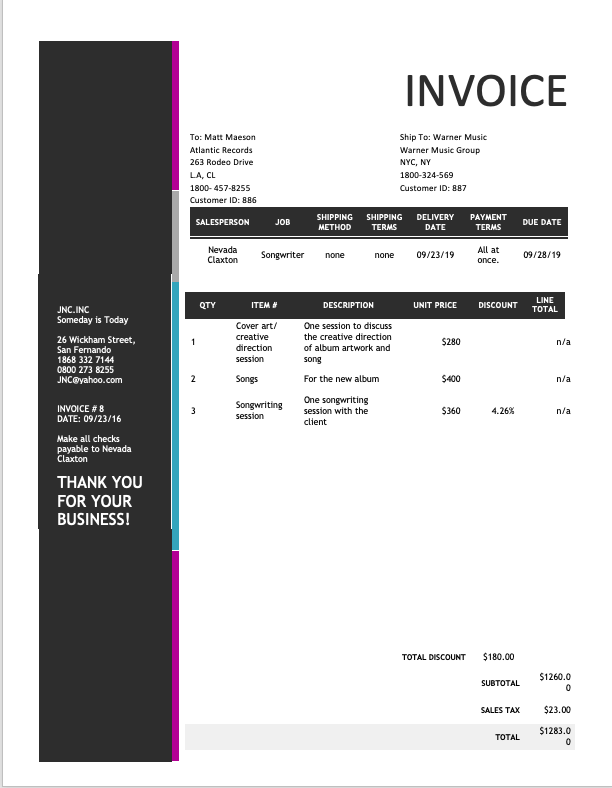
This is an invoice delivered to an artist for songwriting services.
SELF MANAGEMENT
PLANNING & TIME MANAGEMENT
Time management is the process of planning how much time is allocated to certain activities, this allows you to complete all tasks diligently, lowering stress and ensuring accurate completion. As head of A&R, time management is important as days must be planned concisely in order to prioritize tasks and be successful not only within meetings but within the artist roster and their careers. An example of this is overseeing the recording process of an artists such as Judah & The Lion while also talent scouting through attending shows of lesser known artists on YouTube or Soundcloud and listening to demo’s sent to the office by established music industry professionals such as producers and agents, as unsolicited material cannot be accepted. As the label is always looking for new artists, it is necessary that no time is wasted as there are many meetings to plan and attend plus time must be spent with the artist due to me being a gatekeeper to the industry.
In order to keep on track of the day to day, I create schedules and reminders to make sure that I don’t forget to complete anything or run behind schedule, setting alarms and leaving enough time to get to different locations and complete tasks is important as I would rather overestimate the amount of time it would take me to do something and be ahead rather than underestimate and fall behind. Planning is a huge part of time management, as it helps make everything more efficient by allowing you to know when and where you must be to get tasks done and at what times. In the process of breaking down the day, you can allocate specific times to certain activities that don’t have a time of immediate importance. Planning is very important as an A&R exec as I must know when I am available to have meetings with higher ups, talent scout and meet to improve the careers of those already signed to the label. It is useful to write down events I plan to attend and it helps to know if any of these dates or times clash with other commitments for example if I have planned to listen to artists demos on October 7th but also have a concert for an upcoming artist to attend, I must know and decide of which is more important or can be done later, having a clearly laid out schedule can help with this process.
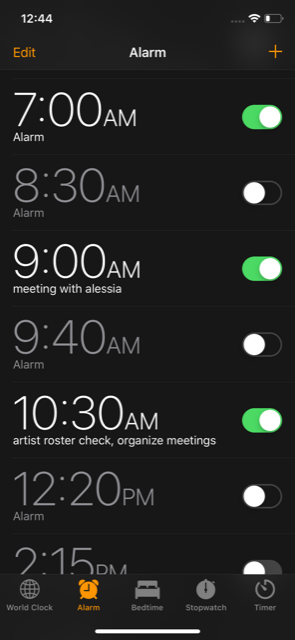
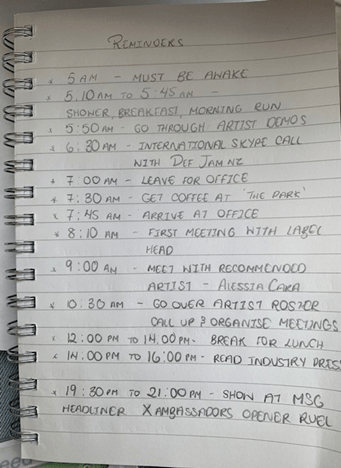
Both the schedule and alarms set for September 10th, 2019
Occasionally, I do forget to set my schedule and am late to shows and recording sessions due to traffic or grounded flights in the result of bad weather, on other occasions I may fall behind in one task and have a hard time catching up to the others therefore making sticking to the schedule difficult. Some days, the schedule doesn’t completely align as meetings must be postponed or may be cancelled etc., therefore causing changes to my day and its layout. Major interruptions to my schedule can throw off the way an artist can work and therefore is not an ideal situation.
To improve my time management, I know I must make sure all necessities are completed before taking time for a break to avoid having to spend extra hours after the workday to catch up.
Time management training courses could help with this. Through attendance I can learn how to better manage my time, distractions and errors that may occur. A course like this will help me to improve my flexibility to change, among other things.
As I become more successful and move up the hierarchy, longer work hours will be expected of me, therefore the way I manage time will have to change in the slightest to accommodate family time and personal matters. Naturally, I will become accustomed to hectic schedules and learn to better manage my time, but it will only become increasingly difficult to balance it all the more successful I get.
GOAL SETTING AND RESPONSIBILITY
As an A&R exec it is important to set goals not only for myself but for those on the label’s artist roster. Goal setting helps you to not only achieve but also helps in the visualizing a clear pathway to how to achieve the goals you have visualized; without an objective it is nothing but a dream without a plan. This process is important as without clear set goals you will become comfortable with where you are, which in short term may not affect you but will keep you back long term, as you aren’t making much progress. In this business planning ahead is important as it is how you have a successful career.
Following the ‘SMART’ abbreviation (Specific, measurable, achievable, realistic, time bound) can help you ensure that you’re aiming for meets the criteria of a successful goal. A more specified goal for a specific avenue is usually more successful than one on broad terms. If the goal is measurable it’s easier to see the progress made for example, the process of transitioning a rising star from arenas to stadium shows and successfully selling out first priority seats to their first stadium gig in less than five minutes, is a measurable goal, as you can judge the progress made. There are always check points to ensure that I am on track to achieving what is best. You must also weigh out whether the goal is achievable for example a smaller artist on the roster such as Thirdstory may be able to sell out smaller venues such as the Scala but would have a harder time selling out the 02 or SSE arena than an artist such as Shawn Mendes as their fanbase isn’t at the same outreach level, therefore setting them up for a large scale European tour would not be realistic as not enough tickets would be sold to keep the shows going. Over time, by working with the group, releasing albums, ep’s, merch and other products and growing their fanbase, playing bigger venues will become a more realistic goal and achievable as once they have their minds to it and perform to a high standard it can be done.
As an A&R exec a goal consistently set for myself is to ensure that I set unsigned and sometimes even established artists up with the right labels for their sound and creative direction, amongst other things. As I must continue to work closely with the artist after, acting as a liaison between them and other departments including label head, I must remain a diligent advisor who will help nurture a certain sound and image by aligning artists with the right producer and offering the best creative input.
For an unsigned musician, A&R can be the gatekeepers to the industry, therefore making it our job to find marketable music and artists for the companies we are employed by. A&R reps are the musicians’ point of contact at the label during contract negotiations, we also play an important role in development of the artist, marketing and sometimes even choose songs for the musicians to record if they don’t write their own material. We play a key role in building a basic promotional foundation for albums and the musicians. This means as the first point of contact I must know and maintain my vision for the artist, this is because my career success also depends on their success. Goals I have include signing at least two new artists every 3 months, begin the process of album visions for Charlotte Lawrence- this includes artwork, sound for this era, future singles release of the three best of the twenty songs she has written and finalization of the album track list for Sabrina Carpenter’s third full length album. As I become more successful my goal setting will change as I will have to be more ambitious and set larger ones, especially as artists on the roster grow.
As A&R exec I am responsible for overseeing all activities within the department and must report back to the head of the label. I am responsible for finding and signing new music talent, the budget of the department, managing the staff, hiring new staff and researching and scouting artists, I must take responsibility for errors made in these areas and make the necessary arrangements to improve them instead of tossing the blame on someone else. This means I must answer to higher ups on any major departmental error.
 Aaliyah Claxton Freelance Blog